All papers
Read the paper
Pinned source
Guided evidence · no prior context required
See the idea before reading the machinery.
These demos are not five random apps. Each one isolates a different claim. Follow the actions below and you will know what the screen is trying to demonstrate before any protocol vocabulary appears. The small puzzles are explanatory models; the linked release applications and tests are the implementation evidence. Every puzzle also includes a copyable prompt so you can build an independent proof with any LLM.
The idea in 20 seconds
The screen is not the source of truth.
Every accepted action becomes a small record called a frame. The app rebuilds what you see by replaying those frames. If the replay cannot recreate the same world, the claim has failed.
Start with the board
Can the application prove what happened by rebuilding itself from its history?
Frame One accepted fact: add a card, move a person, fire a shot.
Chain The ordered history. Every frame points to the one before it.
Projection The board or 3D world rebuilt from that history.
The five-minute path
Do the demos in order. The first teaches the core idea; the remaining four show why the idea matters.
1 · Start here
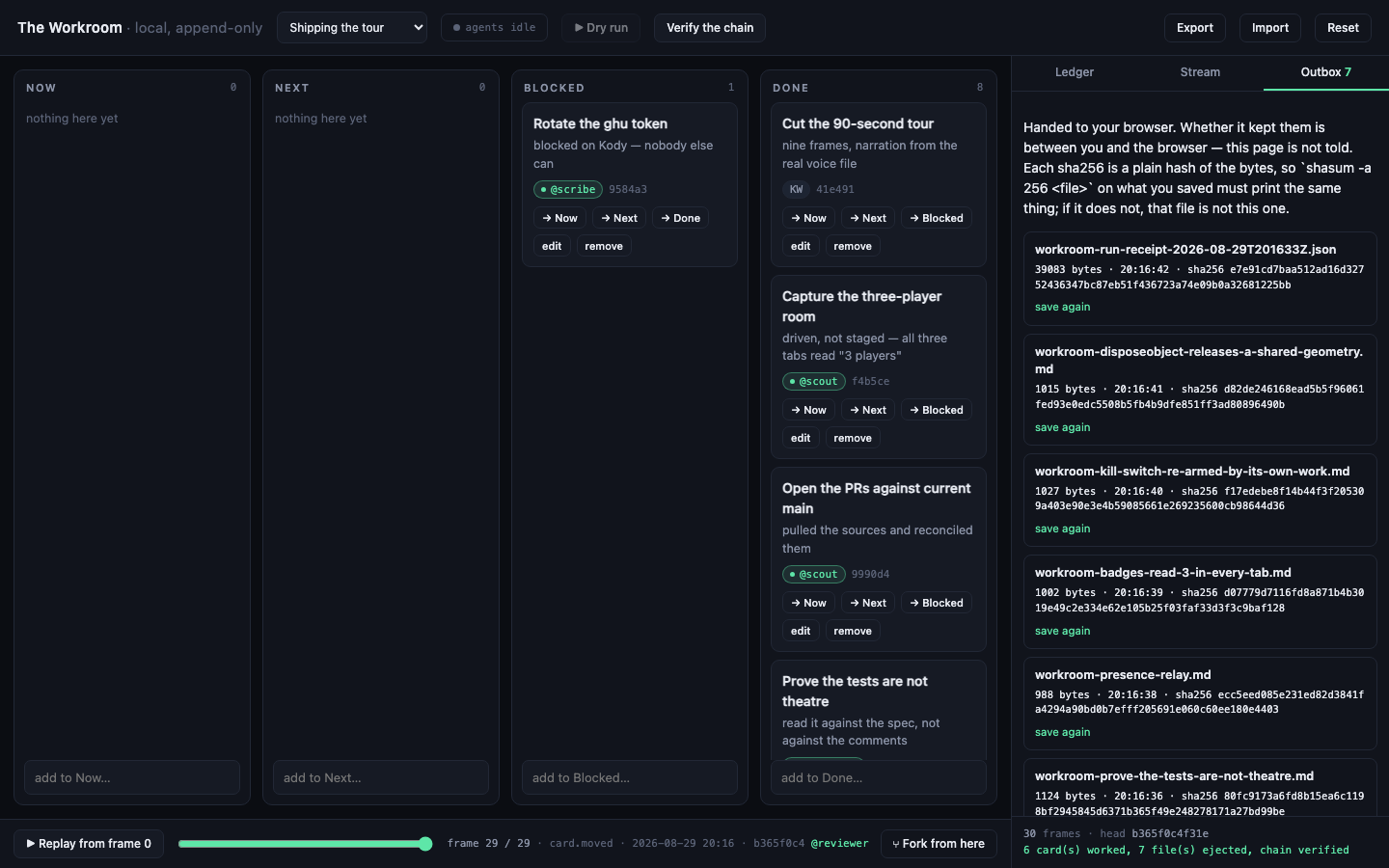
Workroom: throw away the board and rebuild it
About 90 seconds
What you are looking at A normal project board, except the cards are not the record. The frame ledger is.
Do this Click Replay from frame 0 . Watch the empty board fill one action at a time. Click Verify the chain . Watch for The board, ledger, caption, and highlighted card change together. Returning to now restores the exact live board.
What this demonstrates For this event schema and reducer, the board can be deleted and re-derived. The history is upstream of the interface.
Try the replay puzzle
Open Workroom
2 · Same history, another browser
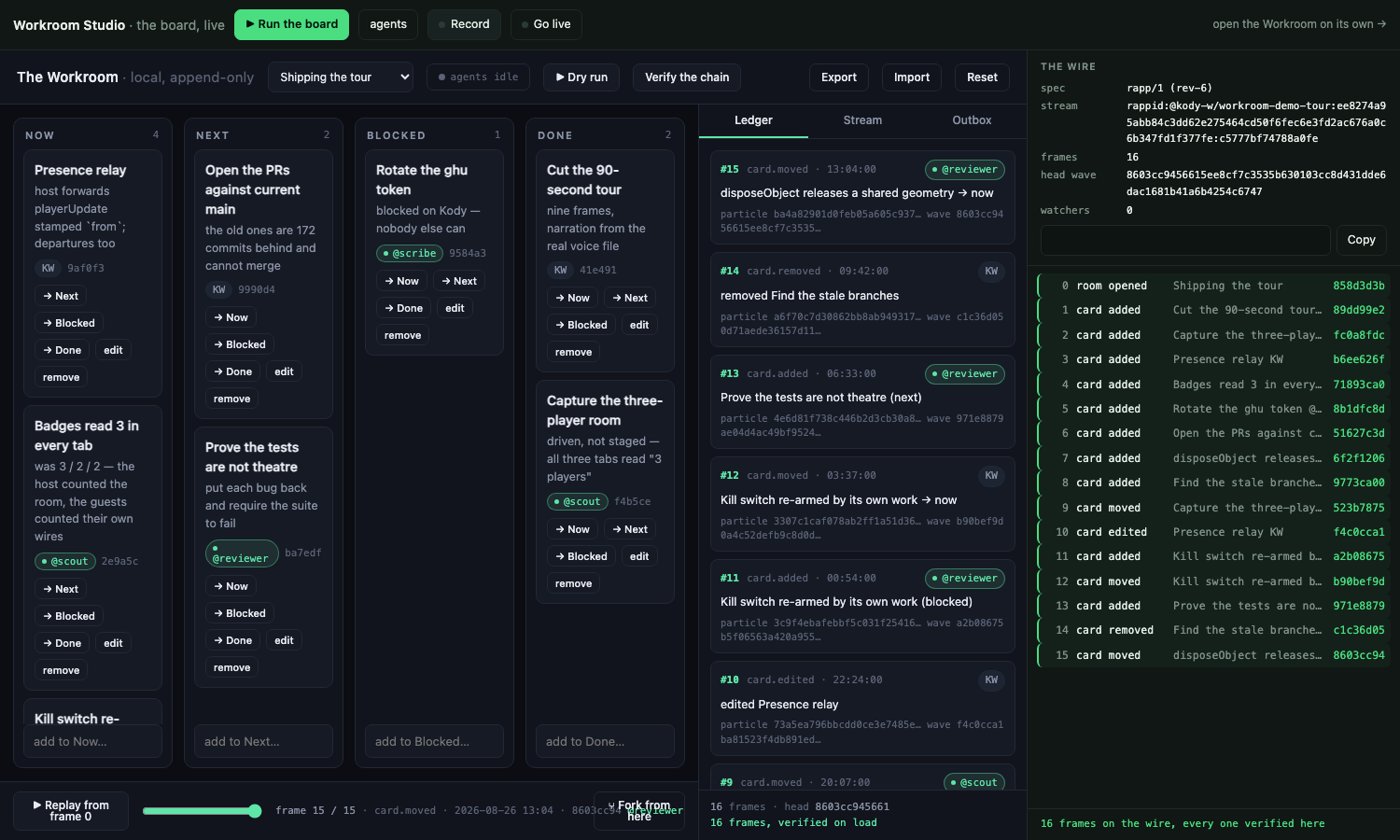
Studio: send frames, not a video of the board
About 60 seconds
What you are looking at The board is on the left. The exact frames it commits appear on the wire at right.
Do this Click Run the board . Watch new wire rows arrive. Click Go live and open the watcher link in a second tab. Watch for The watcher builds its own board from verified frames. It does not receive the first board's pixels.
What this demonstrates Under the shared validator and reducer, two browsers can independently derive the same state from the same accepted history.
Try the chain puzzle
Open Studio
3 · One authority, two views
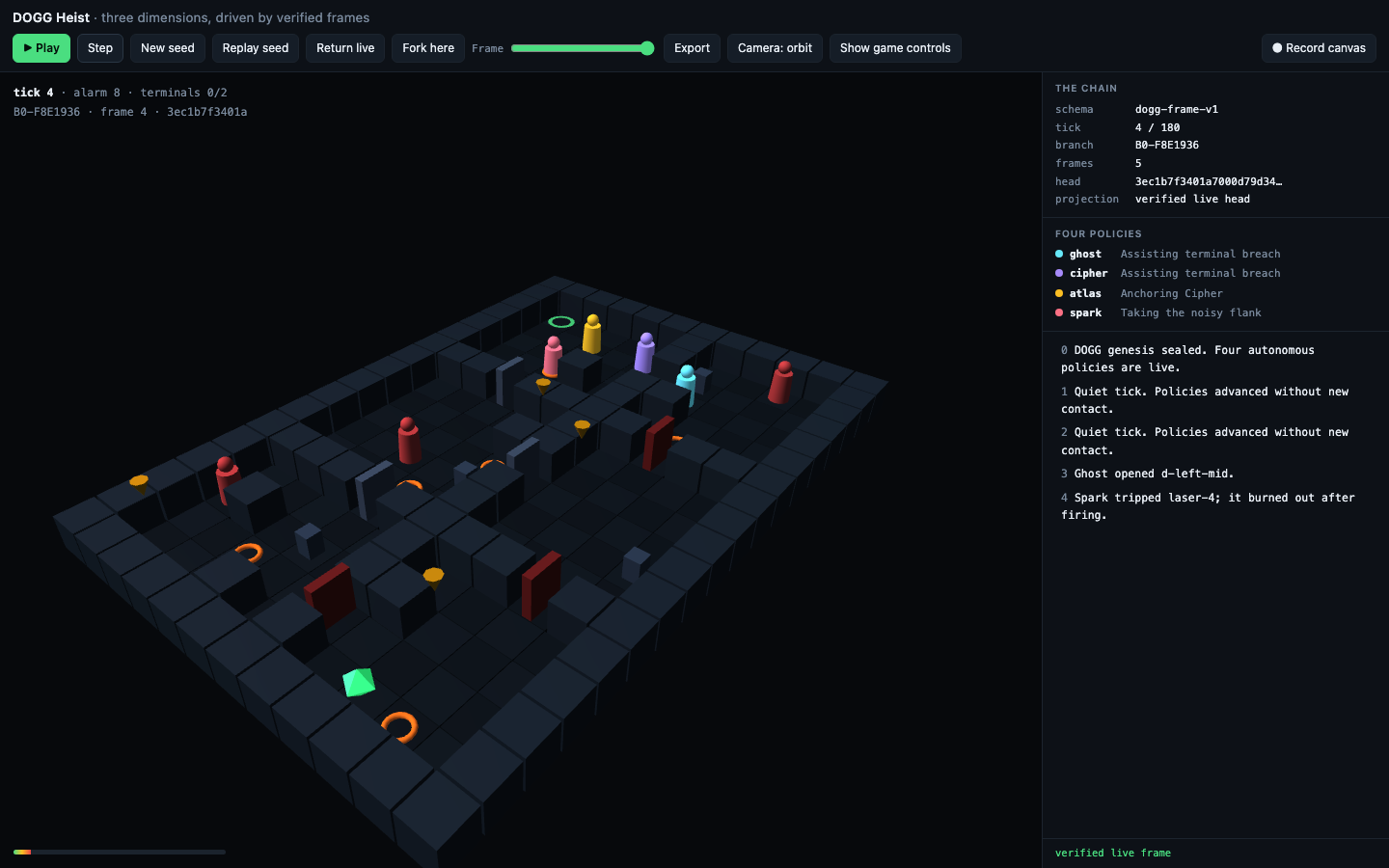
Heist: the 3D room does not contain the game rules
About 45 seconds
What you are looking at A 3D projection of a separate game authority running inside the page.
Do this Click Step several times. Click Show game controls . Move the timeline backward, then return live. Watch for The flat authority and the 3D scene describe the same selected snapshot. The 3D shell cannot invent a move.
What this demonstrates A renderer can remain replaceable while one verified authority owns this model's state transitions.
Try the write-gate puzzle
Open Heist
4 · A room with memory
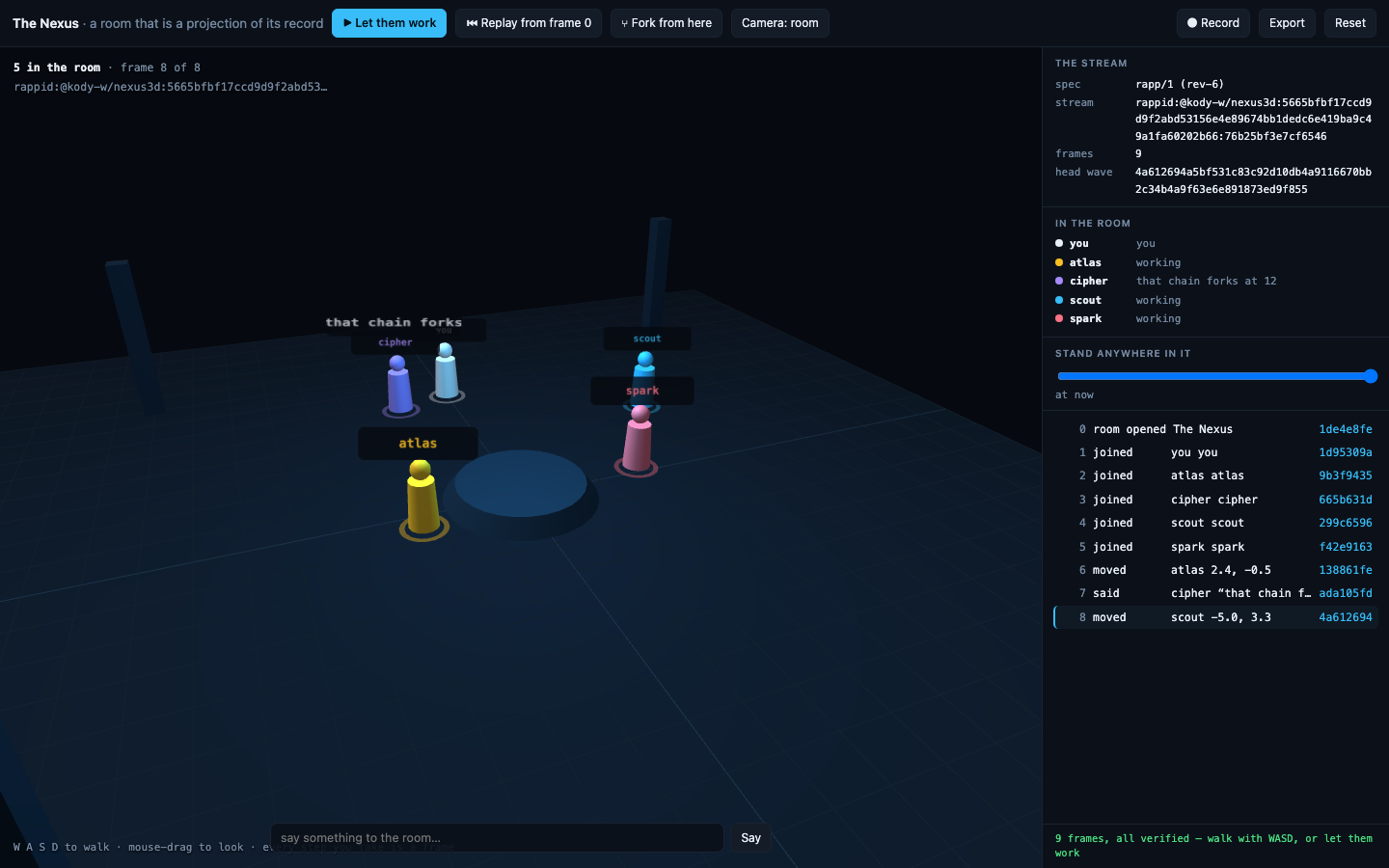
Nexus: every arrival, step, and sentence is replayable
About 60 seconds
What you are looking at A shared room whose residents and speech are reconstructed from frames.
Do this Click Let them work . Wait for movement or speech. Drag the history slider backward, then press Replay . Watch for The roster, bodies, speech, and frame counter all return to the selected moment.
What this demonstrates The accepted event history can reconstruct this spatial social world, not just a list of database changes.
Try the fork puzzle
Open Nexus
5 · Causality, not just chronology
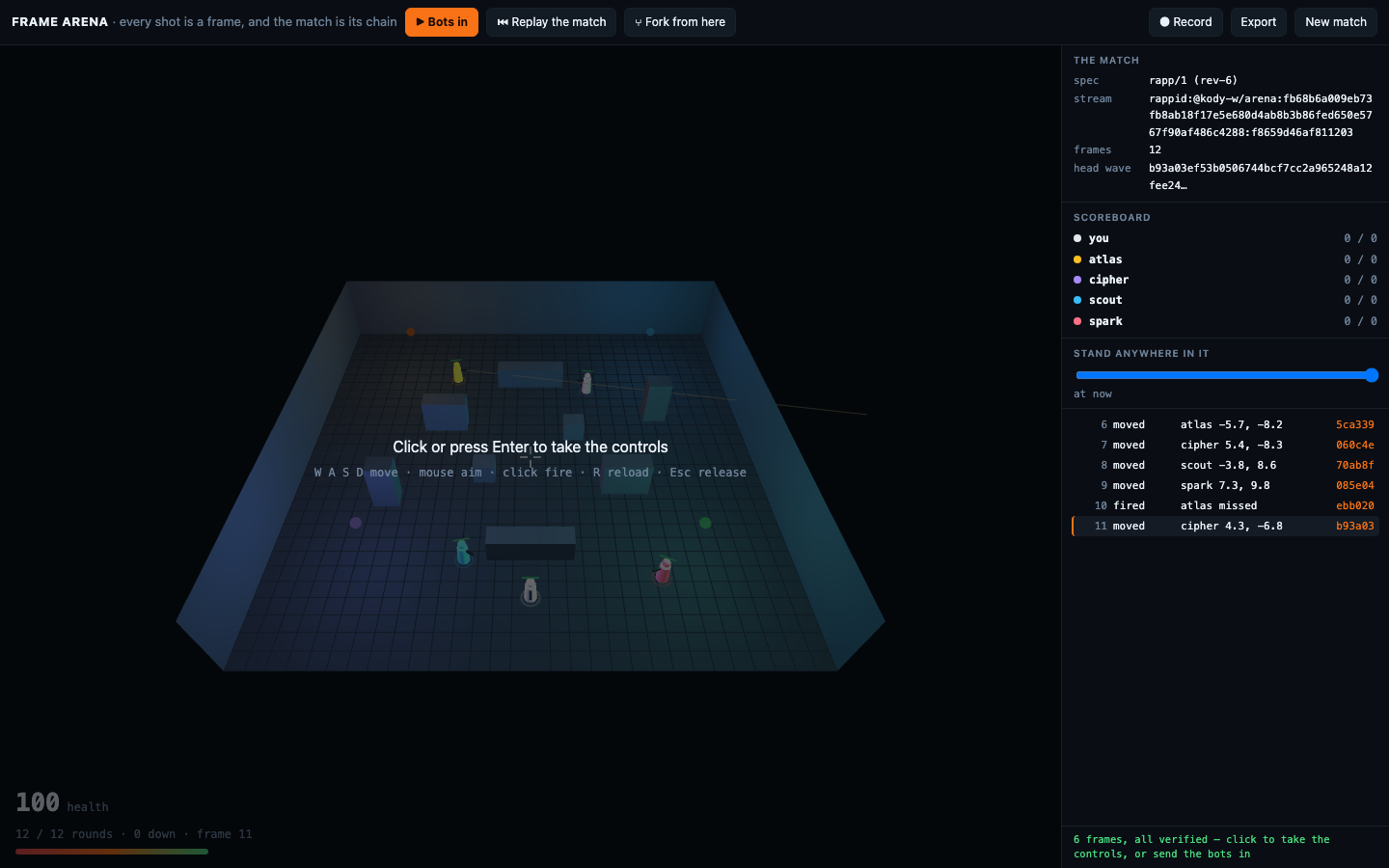
Arena: a death must be downstream of one exact shot
About 60 seconds
What you are looking at A first-person match where movement, shots, hits, deaths, and respawns are separate frames.
Do this Click Bots in . Watch the frame ledger for fired , hit , and died . Replay the match from frame 0. Watch for Each hit names one exact unconsumed shot. A death names the lethal hit and the same attacker.
What this demonstrates The modeled transition rules can validate explicit shot→hit→death causality, not merely sort events by time.
Try the causality puzzle
Open Arena
What failure looks like
A useful demo must be able to say no. Tampered hashes, stale tabs, impossible moves, reused shots, invalid rollbacks, and failed storage writes are refused instead of being painted as success. The red status text is part of the evidence, not an error to hide.
Now the paper has something concrete to name.
The paper explains the architecture and adversarial evidence. The guided path gives each claim a visible action and expected result first.
Read Verified Frame Worlds